Linear regression tells you where a company is headed. But it misses the turning points. Velocity — the first derivative — tells you when momentum shifts. That's often the only signal that matters.
Think of a ball thrown upward. At its peak, position is highest — but velocity is zero, about to go negative. Linear regression at that moment says "going up!" Velocity says "about to come down."
Where is the company right now? What's the overall trend direction? Good for understanding current state, but blind to turning points.
How fast is change happening? Which direction is momentum? Captures acceleration and deceleration — sees turns before they complete.
| Question | Linear Regression | vs | Velocity Analysis |
|---|---|---|---|
| What does it measure? | Overall direction | → | Rate of change |
| What does it miss? | Curves, turning points | → | Long-term direction |
| Best for... | Confirming trends | → | Timing decisions |
| Warning signal | Slope turns negative | → | Velocity turns negative (earlier!) |
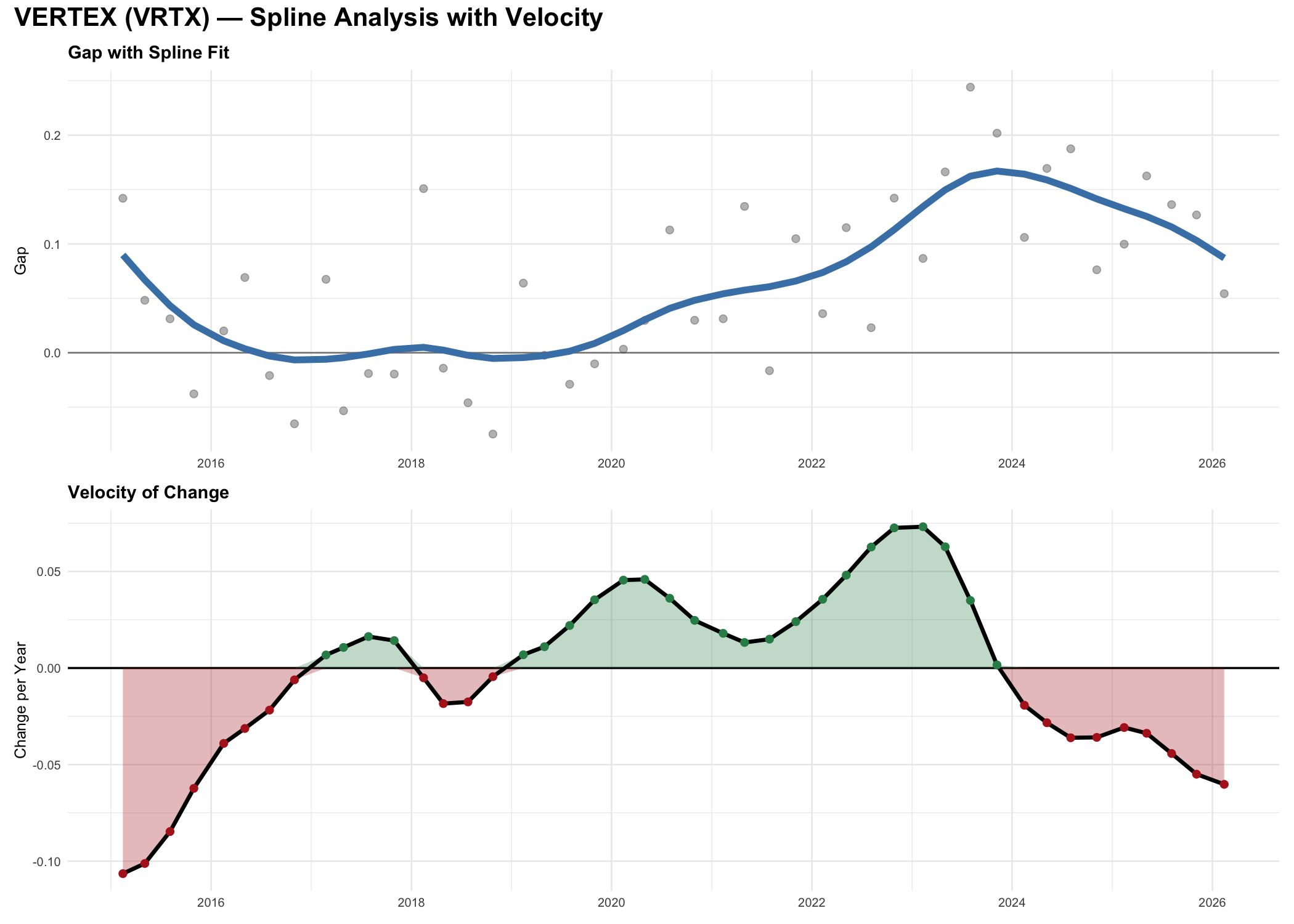
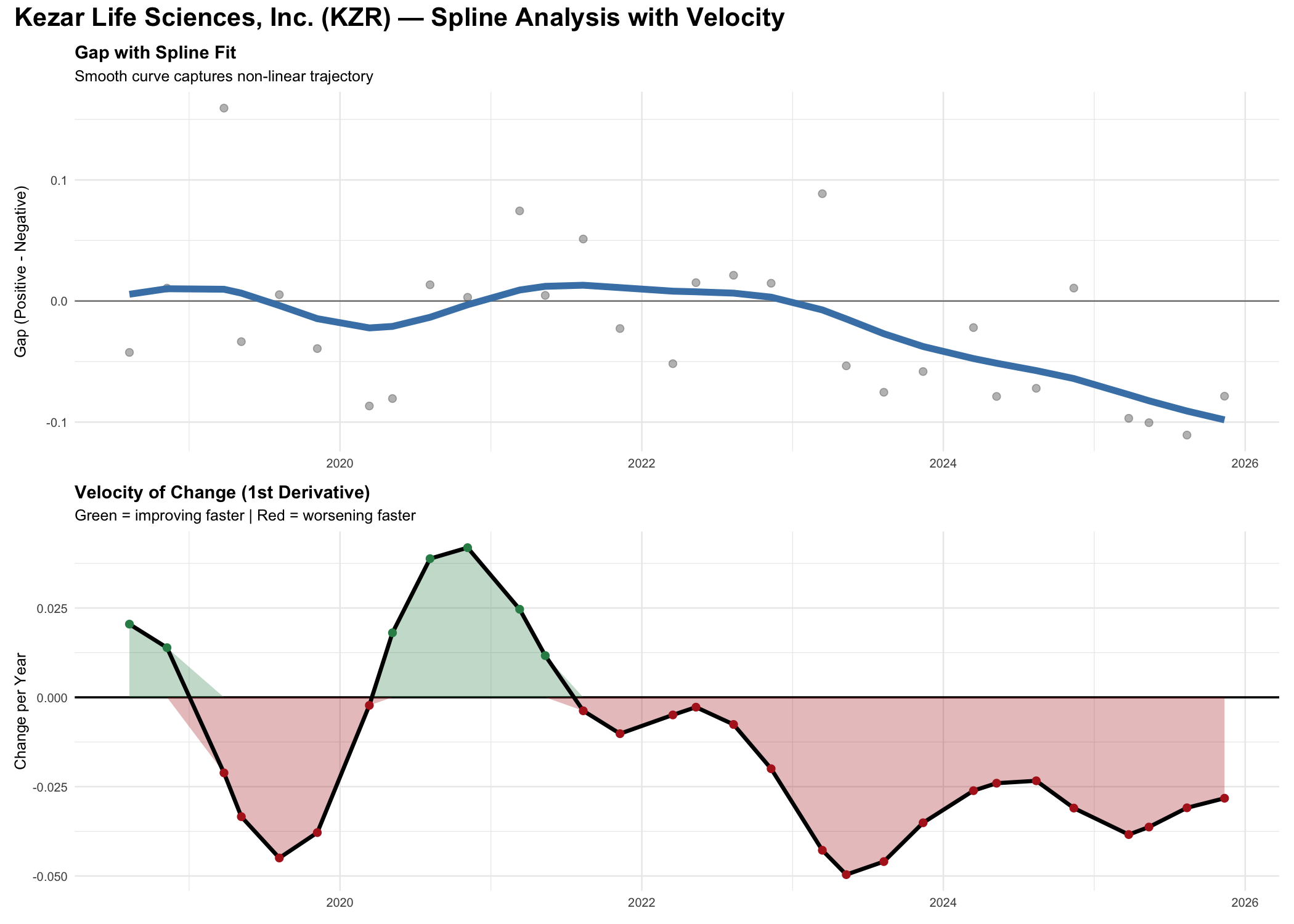
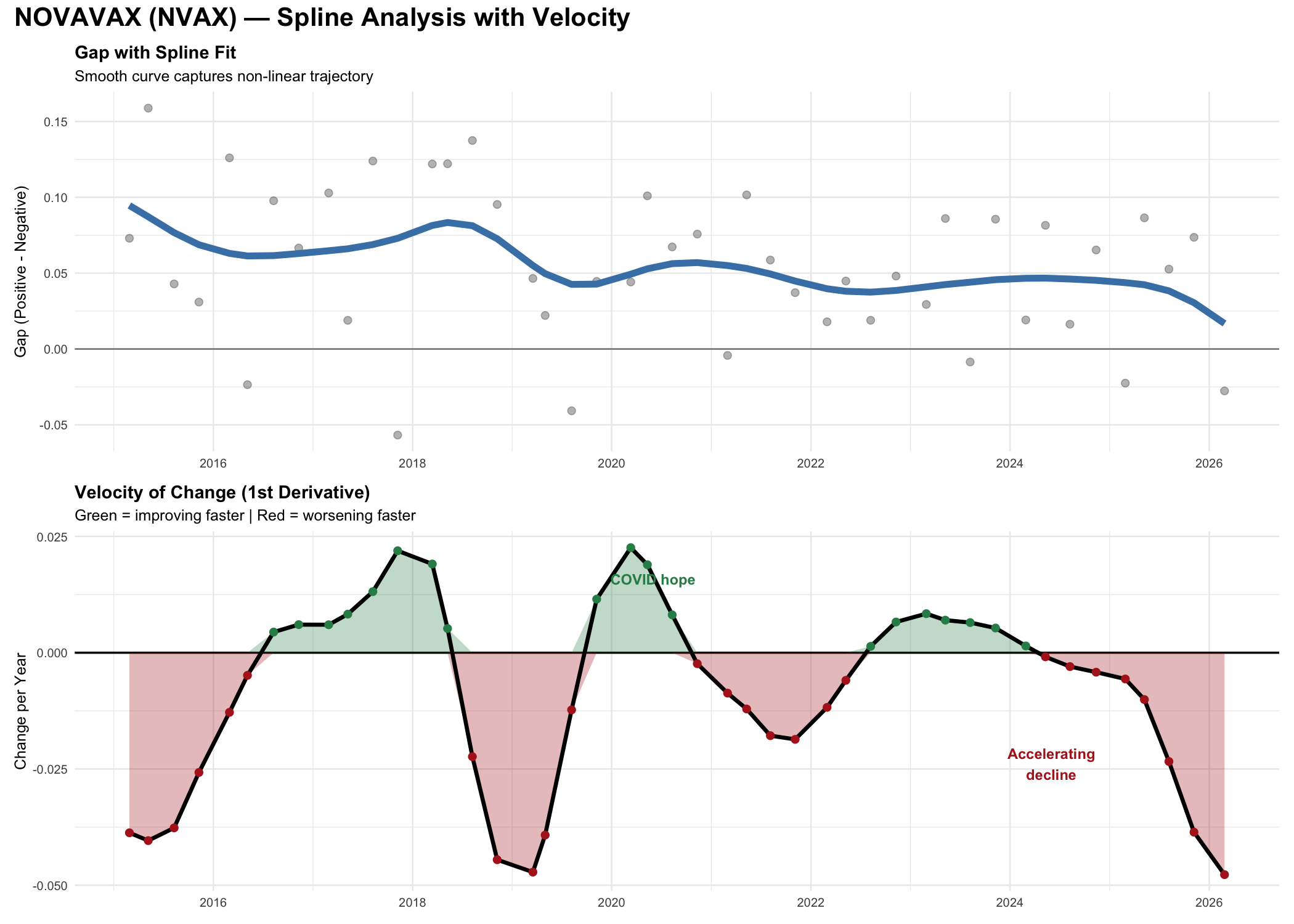
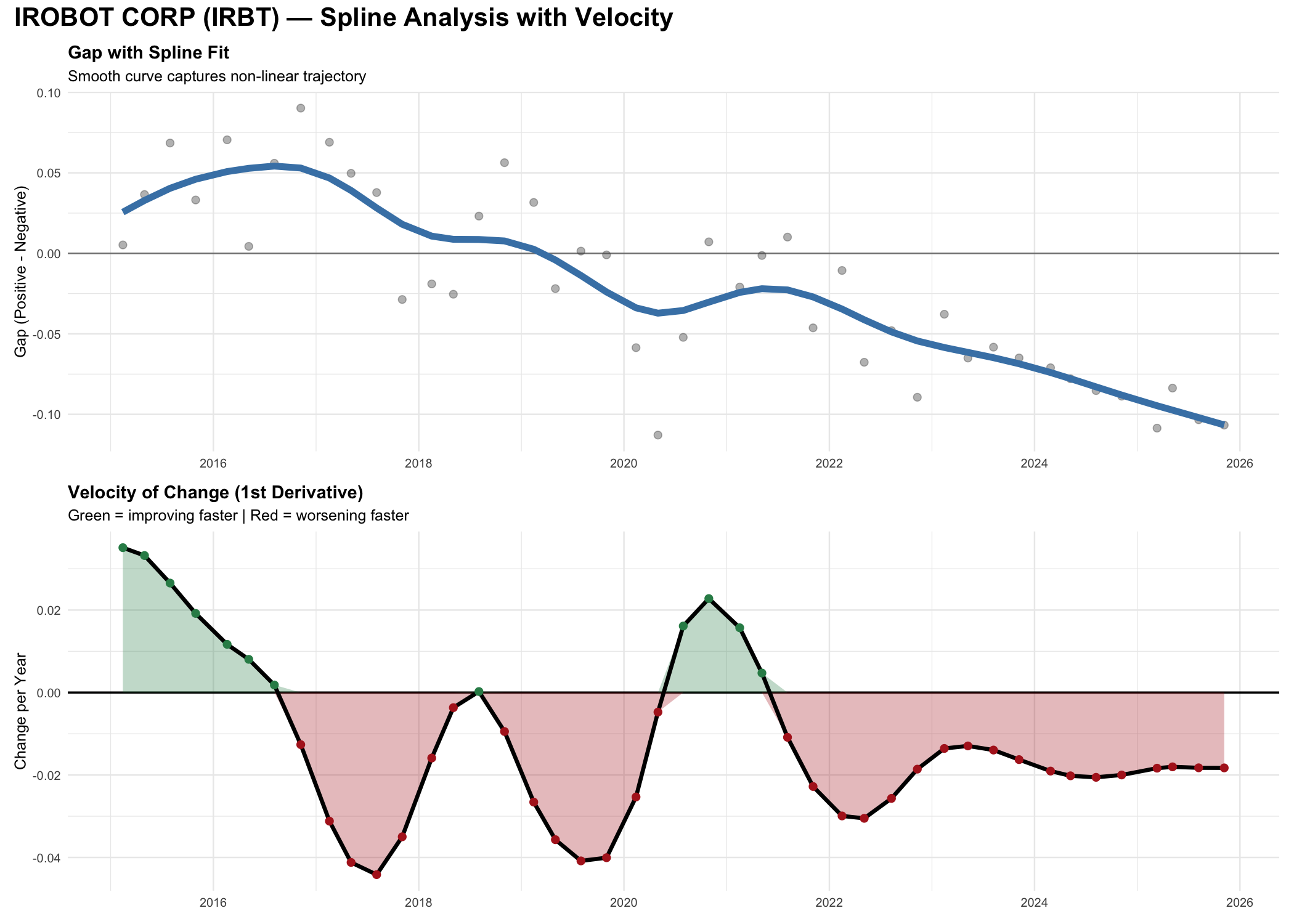
Each chart has two panels. The top shows the smooth trajectory. The bottom shows the velocity — how fast things are changing at each point in time.
The blue curve is a smooth spline fit through the data points. It captures non-linear movement that a straight regression line would miss. The gray dots are individual filings.
The first derivative of the spline. Green fill = improving faster. Red fill = worsening faster. The line crosses zero at inflection points.
Positive velocity means the gap (positive signals minus negative signals) is increasing. The company is improving, and the rate of improvement is captured by the height.
Negative velocity means the gap is shrinking or going negative. Even if position is still positive, red velocity warns that momentum has shifted — trouble may be coming.
Smooth splines with spar = 0.6 balance flexibility and smoothness.
Higher values = smoother curves. Captures non-linear trajectories that linear regression misses.
First derivative of the spline, multiplied by 365 to express as "change per year." Positive = improving faster. Negative = worsening faster.
Mean of 9 positive signals minus mean of 9 negative signals, normalized by sentence count. Positive gap = more good news than bad. Negative gap = distress dominates.
positive_outcome, indication_expansion, accelerated_timeline, regulatory_milestone, approval_event, clinical_trial_milestone, revenue_growing, completed_event
litigation_related, enforcement_action, regulatory_setback, negative_outcome, cost_cutting, financing_desperation, going_concern_warning, debt_related
10-K and 10-Q filings from 2015 onwards. Minimum 4 filings required for spline fitting. Earlier data may be sparser for newer companies.